

Every classroom has moments when a student hits a wall. The sensory environment gets too loud, a transition catches them off guard, a social interaction goes sideways, or the accumulated demands of the morning finally overwhelm their ability to cope. What happens next depends almost entirely on whether there’s a plan in place.
A calming corner is that plan. Done right, it’s one of the most powerful self-regulation tools a classroom can have. Done wrong, it becomes a hangout spot, a punishment corner, or an unused pile of cushions that no one quite knows how to use.
Here’s how to build one that actually works — in any classroom, at almost any budget.
What a Calming Corner Is (and What It Isn’t)
A calming corner is a designated space where students go to self-regulate — to bring their nervous system from a dysregulated state back to a level where they can re-engage with learning. It’s a proactive tool, not a reactive punishment.
This distinction matters more than anything else about the setup. If students associate the calming corner with being in trouble, they won’t use it when they need it most. If they see it as a place they choose to go when they recognize they’re struggling, it builds the most important skill of all: self-awareness about their own regulation state.
A calming corner is NOT:
- A time-out chair with a new name
- A place students are sent as a consequence
- A reward for good behavior
- A free pass to avoid work
A calming corner IS:
- A self-regulation station with specific tools and expectations
- A place students learn to go voluntarily (with guidance at first)
- A short stop, not a destination — the goal is always returning to the group
- Available to every student, not just those with IEPs
Essential Components
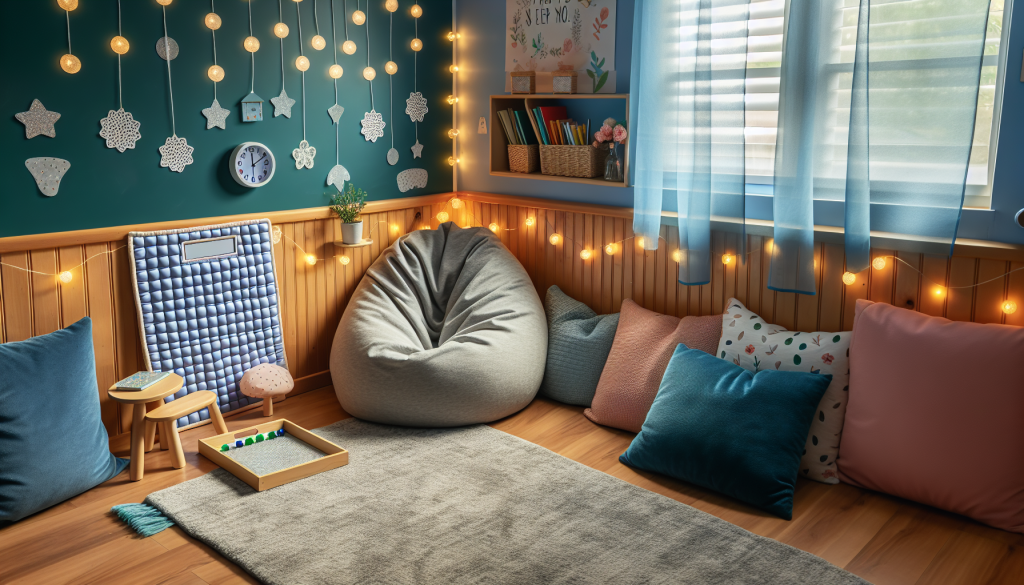
You don’t need a big space or a big budget. A calming corner can be as small as a 3×3 foot area in the corner of a room. What matters is what’s in it and how it’s used.
Comfortable Seating
The seating needs to feel different from a regular classroom chair. That shift in body position is part of the sensory reset. Options that work well:
- A Rocking Soft Sensory Chair provides gentle vestibular input through rocking and proprioceptive input through the soft, supportive sides. The rocking motion is inherently calming for most students and gives them something rhythmic to do with their body while they regulate.
- A Kurve Rocker serves a similar function with a different form factor — the curved base allows gentle rocking while the open design works for students who don’t want to feel enclosed.
- Floor cushions, bean bags, or a folded yoga mat also work. The point is a seating option that signals “this space is different.”
Weighted Items
Deep pressure input is one of the fastest ways to activate the parasympathetic nervous system (the “rest and digest” response that counteracts fight-or-flight). A Weighted Lap Pad is ideal for a calming corner — the student places it across their thighs while sitting and the evenly distributed weight provides proprioceptive input that helps bring the arousal level down.
Weighted lap pads are preferable to weighted blankets in a classroom calming corner because they’re smaller, easier to clean between uses, and the student can place them independently without help.
Fidget Tools (The Right Ones)
A small container with 3–5 quiet, tactile fidgets. Textured balls, smooth stones, silicone shapes, or therapy putty. Resist the temptation to fill the calming corner with every fidget you own — too many choices is stimulating, not calming. Rotate items monthly to maintain interest.
Visual Timer
A visual timer (the kind that shows time remaining as a colored section that shrinks) serves two purposes. First, it helps the student understand that the calming corner is a temporary stop — they’ll return to the group when the timer ends. Second, it removes the subjective judgment call about when they’ve been there “long enough.” The timer is the boundary, not the teacher’s patience.
Three to five minutes is a typical calming corner visit. Adjust based on the student and the situation.
Visual Calming Tools
A visual support that guides the student through a calming strategy. This could be:
- A laminated card with 3–4 breathing exercises illustrated step by step
- A “feelings check-in” chart where students identify their emotion before and after using the corner
- A simple choice board: “I can try: deep breaths, squeeze a fidget, use the lap pad, rock in the chair”
The visual support is critical because a dysregulated student can’t access complex verbal instructions. They need something visual, concrete, and immediately understandable.
Sound Reduction (If Possible)
Noise-reducing headphones are a valuable addition if your budget allows. For students whose dysregulation is driven by auditory overstimulation, headphones can immediately reduce the input that’s causing the problem. Standard over-ear noise-reduction headphones (not noise-canceling with electronics — just passive reduction) work well and are durable enough for shared classroom use.
How to Introduce It to Students
Rolling out a calming corner is as important as building one. If you just put it in the room and hope for the best, it will be misused within the first week.
Teach the Language First
Before the corner is even set up, start teaching self-regulation vocabulary:
- “My body feels revved up / slow / just right”
- “My engine is running high / low / just right” (the Zones of Regulation or Alert Program language, if your school uses those frameworks)
- “I need a break to help my body calm down”
When students have the language to describe their internal state, they can make the connection between what they’re feeling and what to do about it.
Model It
This is the step most teachers skip, and it’s the most important one. Use the calming corner yourself. Tell the class: “I’m feeling a little frustrated right now, so I’m going to take two minutes in the calming corner to do some deep breathing.” Then do it. Come back and say, “That helped. I’m ready to keep going.”
When the teacher models the behavior, two things happen. It normalizes the calming corner as something everyone can use (not just “problem students”), and it demonstrates the exact sequence: recognize the feeling, go to the corner, use a tool, return to the group.
Practice During Calm Times
Have every student practice using the calming corner during a calm, structured time — not during a meltdown. Walk them through each tool. Let them sit in the chair, hold the weighted lap pad, try a breathing exercise, and watch the timer count down. When they’ve practiced in a regulated state, they can access the routine when they’re dysregulated.
Establish Clear Rules
Simple, posted, visual rules that every student knows:
- You can choose to go to the calming corner when you need a break (or the teacher may suggest it).
- Set the timer. When it’s done, return to the group.
- Use the tools in the corner — they’re there to help your body calm down.
- One student at a time.
- The calming corner tools stay in the calming corner.
Common Mistakes
Making It Too Fun
If the calming corner has a tablet, favorite books, toys, or preferred activities, it becomes a destination rather than a tool. Students will want to go there to play, not to regulate. Keep it purposeful — calming tools only. No screens, no toys, no reward items.
Using It as Time-Out
The moment you say “Go to the calming corner” in a sharp tone after a behavior incident, you’ve turned it into a punishment. If you need to direct a student there, use a calm, neutral voice: “It looks like your body needs a break. The calming corner is available.” Better yet, teach students to recognize the need and go on their own.
No Teaching or Modeling
A calming corner without instruction is just furniture. Students need to be explicitly taught when to use it, how to use each tool, and how to transition back. This teaching isn’t a one-time event — revisit it monthly, especially after breaks.
Inconsistent Expectations
If one teacher treats the calming corner as a privilege that can be revoked and another treats it as an always-available tool, students receive mixed messages. The calming corner should be available consistently, every day, to every student. If a student is overusing it, that’s data about their regulation needs — not a reason to restrict access.
Budget Tiers
You can build an effective calming corner at nearly any budget. Here’s what that looks like at three levels:
Starter Setup (~$100)
- Floor cushion or folded yoga mat
- Weighted lap pad
- 2–3 quiet fidgets (textured balls, putty)
- Laminated breathing exercise card
- Basic visual timer (sand timer or app on a dedicated device)
Mid-Range Setup (~$300)
- Rocking Soft Sensory Chair or Kurve Rocker
- Weighted lap pad
- 5 fidget tools in a small container
- Visual timer (dedicated classroom timer)
- Feelings check-in chart
- Noise-reducing headphones
- Small privacy screen or bookshelf divider
Comprehensive Setup (~$500+)
- Sensory seating (rocking chair + floor option)
- Weighted lap pad + compression vest (available by request)
- Fidget rotation bin with 8–10 options
- Visual timer + visual choice board
- Noise-reducing headphones
- Privacy partition
- Soft lighting (battery-operated LED lamp or light strip, warm tone)
- Small area rug to define the space
- Feelings journal or regulation reflection sheet
Start Somewhere
The calming corner doesn’t need to be Instagram-perfect to be effective. A cushion, a weighted lap pad, a visual timer, and a breathing card in the corner of a room will do more for student self-regulation than the most beautifully designed sensory space that nobody taught students to use.
Build it. Teach it. Model it. Adjust based on what you see. The students who need it most will show you it’s working.
Need help selecting calming corner products for your classroom or school? Contact us for personalized recommendations based on your budget and student population.
Note: Calming corners are most effective when implemented as part of a school-wide social-emotional learning or sensory integration framework. An occupational therapist can help select appropriate tools and design calming strategies for individual students.
